

Is a construction project going on near you that caused significant damage to your house or building? Are construction defects or poor maintenance causing your home or building to be dangerous? Heavy construction activities including demolition, excavation or jack-hammering are proven to cause major damage. Your foundation may have cracks from the repetitive nature and force of the vibrations. If you've felt your home or building shake or rattle at times during the construction process, and you notice signifcant structural damage, you likely need to pursue a remedy to repair the losses you have sustained.
Cracks may appear in your walls that you know were not there prior to the start of the construction project. Your utility systems or systems may have been altered or disrupted from the vibrations. You need to have the major damages to your home or building repaired, but are unclear about what to do next, and how to prove and recover for the damages caused by the construction related vibrations. The potential sources of recovery include the general contractor, the subcontractor responsible for the vibration causing activity, or your own homeowner’s or building owner’s policy.
Construction Vibrations and Resulting Damage
Machines, equipment and tools used for both the demolition of old buildings, and in excavating foundations for new buildings, can be the source of vibrations that cause damage to nearby structures. Some of the possible damage includes:
- Foundation settling or cracking;
- Major Interior cracking of walls and floors;
- Roof collapse or other structural damage.
- Utility failure or disruption which can cause electrical, gas, water or plumbing related damage.
If you have suffered significant damage that you believe was caused by construction vibration, you likely need to submit a claim to recover for your losses.
Construction Company Responsibility for Vibration Damage
The general contractor in charge of the construction project generally has some level of responsibility for activities at a construction site. Construction contracts, municipal permits and ordinances, and state law often dictates the level of responsibility that a general contractor has for damage caused by the work of subcontractors. They typically have their own liability insurance policy covering them for damage caused by their negligence. Subcontractors typically have contracts with the general contractor which describe subcontractor duties and obligations. The subcontractor contracts usually require the subcontractor to have insurance for damage caused by their activity.
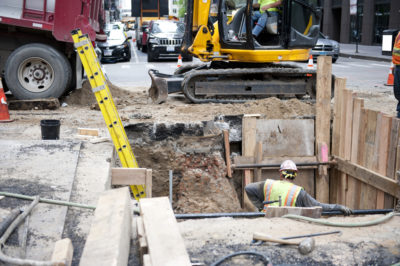
Rules applicable to safe demolition and excavation activity may come from municipal ordinances or state law or from industry standards. One such standard is that a site evaluation be done prior to any vibration causing activity such as demolition or excavation. The site evaluation should include measurements, soil testing and analysis of any potential harm to adjoining properties and structures on adjoining properties.
It has been scientifically established that even seemingly modest demolition and excavation activity can cause vibrations that travel through the earth to adjoining (next door) land and buildings including homes. A company involved in such a project must assess whether the proposed work poses a risk of harm to surrounding property owners. And is a risk is posed, the project must be modified in a way to eliminate the danger to others.
Proving Your Damages and Cost of Remediation or Replacement
Typically, you need one or more experts to evaluate and prove your damages. A structural engineer can evaluate the nature, extent and cause of the damage. A builder or remodeler can supply the scope and cost of work to repair or replace your home or building. For example:
- Did any items fall off of any shelves during blasting by the construction company
- When did you first notice the cracks?
- If the cracks have gotten worse, when did you first know there were cracks and how have they changed?
- Do you have any photos or reports of the condition of your property prior to the construction?
The engineer will also evaluate how close your home is to the construction project and damaging machines, equipment and tools that were used. One of the issues is to prove that the damage was not preexisting and was, in fact, caused by the construction activity.
In 2015 in Chicago, the construction of a 51-story hotel and arena for the DePaul University basketball team caused vibration damage to an older nearby home resulting in structural damage to the home. The owner said that when the ground moves, “my house moves.”
The owner’s homeowner’s insurance company sent a professional to inspect her home and evaluate the damages. As it turns out, he was the same inspector who had initially inspected her home prior to her purchase eight years before, so he had prior knowledge and documentation of the previous condition of the home. He could speak with authority that the damage he found in the home was “not at all present when she bought it.”
Homeowner’s or Building Owner’s Insurance Claims for Vibration Damage
A standard homeowner’s insurance policy or building owner’s policy provides coverage for structural damage to the home or building when the damage is caused by fire, wind damage caused by a hurricane, lightning, and other disasters. However, most policies have an exclusion from covering damages caused by “earth movement.”
When you present a claim for vibration damage, the first response of the insurance company is often to deny the claim on the grounds that damages due to “earth movement” are not covered.
The exclusion is generally interpreted to refer to damages caused by an earthquake. So, unless the policy specifically excludes coverage for “earth movement” damages caused by “man-made events,” the policy will likely cover your vibration damages.
The difficult part may be in proving the damage was caused by earth movement due to construction vibration. You really need a construction damage attorney experienced in dealing with insurance companies who knows how to prove coverage and force payment of claims.
An Experienced Construction Damage Attorney Can Help
We can assist you in proving the cause and the extent of the losses you have sustained due to construction activity or poor maintenance. It is important to have all documentation, including photographs, and details as to dates and times of activity and damages sustained.
The process can be involved. We suggest that if you believe construction vibration damage in excess of $100,000 to your home or building, contact our experienced construction damage attorneys at the Blumenshine Law Group (312)766-1000 or email at [email protected] for help in pursuing your claim for recovery. We offer a no-obligation free case consultation.