Chicago Rear-End Accident Lawyer

Scott Blumenshine
December 9, 2025

Get a Free Case Evaluation

Complete the form for a 

free case review

testimonials

M, Bentley

Thank you for taking my case and being so kind and considerate and never forgetting to update me on where we were in the process. Thank you Scott and Catalina and anyone else that worked on my case.

Natalie A. 

I was in an accident and hired this law firm to represent me, I was very satisfied with the outcome. If I have more legal needs in the future I will give them a call.

Download Free e-Book - Uninsured, Hit and Run and Underinsured Motorist

Am I Covered ebook

In Illinois, rear-end collisions are often legally straightforward, but financially complex. While state law generally presumes the rear driver is negligent for following too closely, insurance companies have developed aggressive tactics to devalue these specific claims.

At Blumenshine Law Group, we know the playbook adjusters use. From the ‘MIST’ (Minor Impact, Soft Tissue) defense to claiming your injuries are ‘pre-existing,’ we fight to ensure that a lack of bumper damage doesn’t prevent you from receiving full compensation for spinal injuries, whiplash, and lost wages.

If you were rear-ended on the Kennedy, Lake Shore Drive, or a local Chicago street, you need an attorney who understands the biomechanics of rear-impact crashes, not just a general injury lawyer.

Why You Need a Chicago Rear-End Accident Lawyer

Typically, the rear driver is mainly responsible for ensuring there is enough stopping distance between vehicles.

However, fault can get tricky. While drivers following you are often deemed negligent for failing to stop in time, the actions of the front drivers can also contribute to the collision. Let’s break down fault and liability:

First, rear drivers must leave ample space between cars and avoid collisions. If they slam into the back of your vehicle, their inattention or failure to brake is the prime cause.

Second, don’t assume the front driver is not to blame! Their actions might have made the crash unavoidable. Sudden stops, wrong signals, dead brake lights, or swerving can endanger the rear car. Sometimes, the front driver’s negligence can lower or even remove the rear driver’s liability.

In Chicago, rear-end accidents usually involve shared responsibility among drivers. For example, the driver behind might be tailgating, while the driver ahead might brake suddenly. In these situations, each driver is given a percentage of fault. Under Illinois’ modified comparative negligence law (735 ILCS 5/2-1116), you can recover compensation as long as you are less than 50% at fault for the accident. Your compensation will be reduced by the percentage of fault you bear. For example, if you are found 20% at fault, your $100,000 award would be reduced to $80,000. This makes it crucial to have experienced legal representation to minimize any fault attributed to you.

Rear-end liability depends on the situation. Usually, the rear car is at fault. However, a careful legal review might reveal that the front driver’s actions or vehicle issues share some blame. An experienced attorney performs a detailed crash analysis and knows how to boost your claim when negligence is involved. Don’t assume the rear driver is solely at fault; many factors can complicate the situation.

Illinois Vehicle Code section 625 ILCS 5/11-710 requires drivers to maintain an assured clear distance ahead that would allow them to stop safely. When a rear-end collision occurs, there is a legal presumption that the following driver violated this duty. However, this presumption can be challenged if evidence shows the front driver’s actions contributed to the crash.

The most clear-cut cases we handle involve a client who was rear-ended while stopped at a red light, stop sign, or in heavy traffic on the Kennedy Expressway. In these ‘stopped vehicle’ scenarios, the presumption of negligence against the rear driver is strongest, often leading to faster settlements.

Why Insurance Companies Deny Rear-End Claims (And How We Fight Back)

After a rear-end collision, many victims are shocked to hear the insurance adjuster say, “Your bumper barely has a scratch, so you couldn’t possibly be injured.”

This is not a medical opinion; it is a calculated denial strategy. Insurance companies use a protocol often called M.I.S.T. (Minor Impact, Soft Tissue) to automatically undervalue or deny claims where vehicle damage is below a certain dollar amount (usually $1,000).

They want you to believe that if the metal didn’t bend, your body didn’t break. Science proves otherwise.

The Physics of “Low Damage” Crashes

Modern car bumpers are designed to withstand low-speed impacts without showing visible damage. However, when a bumper is stiff and doesn’t “crumple,” it fails to absorb the energy of the crash. That kinetic energy is transferred directly through the frame of the car and into your spine.

A 5-mph rear-end impact can generate significant G-forces on the neck and head, causing whiplash, herniated discs, and concussions—even if the car looks pristine.

Common Tactics Adjusters Use to Devalue Your Claim

  • The “Gap in Treatment” Trap “Alongside the MIST defense, adjusters look for any delay in your medical care. If you wait 48 hours to see a doctor because you thought the stiffness would ‘go away,’ they will use that gap to argue your injuries are unrelated to the crash. In rear-end cases, immediate documentation is your strongest weapon against these denials.
  • “Pre-Existing Condition” Arguments: They will dig through your medical history to claim your back pain is from an old sports injury or age, rather than the crash.
  • The Low-Ball “Inconvenience” Check: They may offer you $500 or $1,000 immediately after the crash to sign a release. Do not sign this. It releases them from all future liability, even if you need surgery next month.

How Blumenshine Law Group Proves the Truth

We do not let insurance algorithms dictate the value of your health. We fight the “Low Property Damage” defense with evidence:

  1. Biomechanical Expert Analysis: When necessary, we bring in experts who can demonstrate how the forces of the crash were transferred to your body, proving that “minor” vehicle damage can cause major bodily harm.
  2. Advanced Diagnostic Imaging: X-rays often miss soft tissue injuries. We ensure our clients have access to MRIs and CT scans that reveal the tears, herniations, and nerve damage that adjusters try to ignore.
  3. Visualizing the Impact: We look beyond the bumper. We check the frame alignment, seat mechanisms, and internal vehicle components to show the true severity of the impact.

Don’t let an adjuster play doctor. If you are in pain, you have a case, regardless of what your bumper looks like.

Why Choose Blumenshine Law Group for Your Rear-End Accident Claim?

When you’re injured in a rear-end collision, you need experienced legal representation that understands both Illinois law and the tactics insurance companies use to minimize payouts. Here’s what sets us apart:

Proven Track Record: We have successfully represented Chicago accident victims and recovered millions in compensation, including multiple seven-figure settlements for rear-end collision injuries.

Deep Legal Expertise: Our attorneys have extensive experience with Illinois traffic law, insurance regulations, and personal injury litigation. We stay current on all changes to Illinois comparative negligence law and insurance requirements.

No Upfront Costs: We work on a contingency fee basis, meaning you pay nothing unless we win your case. Our consultations are always free and confidential.

Local Knowledge: Based in Chicago, we understand the unique challenges of our city’s traffic conditions and have established relationships with local courts, medical providers, and accident reconstruction experts.

Available 24/7: Car accidents don’t happen on a schedule, and neither do we. Call us anytime at (312) 766-1000.

Here’s a detailed overview of what to do following a collision and how a lawyer can protect your rights every step of the way.

Why Rear-End Accidents Happen So Often in Chicago’s Busy Streets

Chicago roads are notorious for heavy, stop-and-go traffic, driver distractions like mobile phones, and other hazardous conditions. Rear-end crashes often happen when the rear driver fails to stop in time and doesn’t leave enough following distance between vehicles. Common causes of auto accidents include:

These factors can cause the rear driver to crash into the car in front, violently jolting the occupants inside and potentially causing significant injuries.

Rear-Ended by a Hit and Run Driver?

One of the most stressful scenarios for Chicago drivers is being rear-ended by a hit and run driver who flees the scene immediately after the crash. Many victims assume they cannot get compensation if the other driver is never caught.

This is false. You can often recover damages through your own Uninsured Motorist (UM) policy. However, your insurance company may still fight the claim. Our Chicago hit and run accident lawyers are experienced at proving these claims to ensure your medical bills and vehicle repairs are covered, even if the at-fault driver is unknown.

Chicago Rear-End Accident Statistics

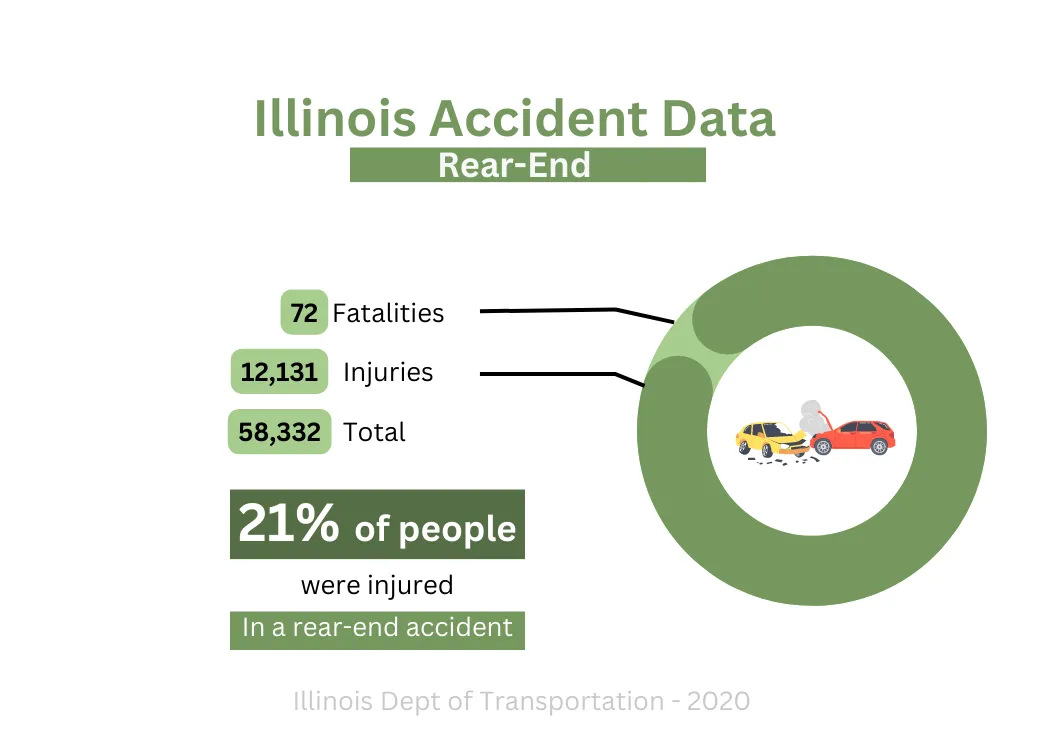
According to the Illinois Department of Transportation (IDOT), rear-end collisions represent a significant portion of Chicago traffic accidents:

  • 68,742 rear-end crashes annually in Illinois (28% of all crashes)
  • 24,617 in Cook County (35.8% of Illinois rear-end crashes)
  • ~15,800 in Chicago city limits
  • Peak time: 4:00-6:00 PM (31% of daily rear-end crashes)
  • Winter increase: 42% more crashes Dec-Feb vs. summer

Contributing Factors (IDOT data):

  • Distracted driving: 38%
  • Following too closely: 31%
  • Failure to reduce speed: 19%
  • Improper lane usage: 8%

High-Risk Chicago Locations: Lake Shore Drive (Fullerton curve, Oak Street Beach), Kennedy Expressway (express lanes), Dan Ryan at 95th Street, Michigan Avenue near Millennium Park, Irving Park & Western Avenue.

Sources: IDOT Crash Data (2023), National Highway Traffic Safety Administration (NHTSA)

Recent Rear-End Accident Settlements in Chicago


Our Chicago rear-end accident lawyers have secured millions of dollars in compensation for clients injured by negligent drivers:


$1,250,000 – Policy Limits

Rear-End Car Crash with Severe Injuries

Our client sustained neck and back injuries in a rear-end collision. He underwent neck surgery (posterior cervical discectomy and fusion) and developed back pain with symptoms radiating into his legs (myelopathy). We recovered the full insurance policy limits.

$1,025,000

Medical Transport Driver Rear-Ended While Working

Our client was a medical transport driver for special needs customers when rear-ended. She suffered neck and back injuries requiring surgery, with myelomacia beginning in the cervical spine. Recovery was from the other driver’s insurer ($25,000), workers’ compensation, and underinsured motorist coverage.

$650,000 – Arbitration Award

HVAC Mechanic Hit by Underinsured Motorist

Our 52-year-old client, a heating and air conditioning mechanic, was injured in a rear collision by an underinsured motorist. He suffered shoulder and back injuries requiring shoulder surgery and implantation of a spinal cord stimulator. A three-arbitrator panel entered the award on the underinsured motorist claim.

$650,000

Lumbar Fusion Surgery After Rear-End Collision

Our 55-year-old client experienced a rear-end collision that led to lumbar fusion surgery three years after the initial crash. The client had pre-existing lumbar spine degeneration. Recovery involved claims against the driver’s liability insurance and the client’s underinsured motorist coverage, resulting in a $450,000 arbitration award.

See our complete case results: View All Successful Settlements


The settlement amounts mentioned are examples only and do not represent what you will receive. No attorney can guarantee a specific outcome or settlement amount.

Common Injuries from Rear-End Collisions in Chicago

Our attorneys have represented clients suffering from virtually every type of rear-end collision injury recognized by Illinois medical and legal standards. Collisions often lead to severe trauma because the body is not designed to absorb the sudden impact forces. Common injuries include:

  • Whiplash and neck trauma – damage to the cervical spine, neck muscles, ligaments, and vertebrae requiring physical therapy or surgery
  • Concussions and traumatic brain injury (TBI) – ranging from mild concussions to severe TBI requiring long-term cognitive therapy
  • Spinal cord damage – including herniated discs, bulging discs, spinal fractures, or partial/complete paralysis
  • Back fractures – compression fractures of vertebrae often requiring surgical intervention
  • Internal organ damage – injuries to kidneys, liver, spleen from seatbelt force or airbag deployment
  • Bruising and lacerations – soft tissue injuries, contusions, and deep cuts requiring stitches
  • Knee/foot/leg damage – fractures, torn ligaments, or soft tissue injuries from impact with dashboard or pedals
  • Psychological trauma – post-traumatic stress disorder (PTSD), anxiety, depression related to the accident

These injuries can result in extensive medical treatment at Chicago-area hospitals like Northwestern Memorial, Rush University Medical Center, or University of Chicago Medicine, expensive rehabilitation, lost income, and permanent disabilities. Sadly, rear-end crashes also result in fatalities, particularly on high-speed expressways.

Immediate Actions After a Rear-End Accident: Chicago Legal Checklist

If you’ve been the victim of a rear-end crash in Chicago, make sure to take these important steps:

Get Medical Attention Immediately 

This is the top priority for any auto accident injury. Even if you initially feel fine, it is critical to get examined by a doctor as soon as possible. Soft tissue injuries and internal trauma often have a delayed onset of symptoms. Pay attention to how you feel. Prompt diagnosis and treatment lead to better long-term outcomes.

Call the Police 

Contact the police department to file an official report for the accident. Having the crash fully documented in a police report is crucial for insurance and legal claims later. Ensure you obtain the responding officer’s badge number and report number.

Gather Accident Evidence

If you can do so safely, take photos of the accident scene, vehicle damage, injuries/bruising, skid marks on the road, and any other relevant evidence—also, exchange insurance and contact information with the other driver involved. 

Consult an Accident Attorney Early

Contact a zealous, experienced car accident lawyer for guidance on your legal rights and options. We can help protect your rights, deal with insurance companies on your behalf, prove liability and fault, and pursue maximum compensation for your injuries, lost income, pain and suffering, and other damages. People often compromise their rights by trying to navigate this complex process independently. Do not give statements or sign anything with the insurance company without consulting one of our lawyers.

How Our Chicago Rear-End Injury Attorneys Can Help You Recover

Retaining legal representation after a Chicago car accident is highly advisable; however, choosing a committed attorney with specific experience in these types of injury cases is crucial. An accomplished rear-end accident lawyer can provide enormous value, including:

  • Performing a thorough investigation of the accident to prove fault and liability on the rear driver
  • Gathering all evidence, like police reports, photos, video footage, and witness statements 
  • Negotiating aggressively with insurance companies and defense attorneys to demand fair compensation 
  • Determining the full scope of damages and long-term costs of your injuries
  • Filing a personal injury lawsuit in Chicago if a satisfactory settlement isn’t reached

Our lawyers essentially take over communication with insurers and defense attorneys, allowing you to focus on your healing. Our competent and committed law firm has the skills and resources to build the strongest possible claim for you.

Legal Compensation Available for Rear-End Accidents in Chicago

As the innocent victim of a rear-end collision in Chicago, you may be entitled to legal compensation under Illinois personal injury law (735 ILCS 5/2-1115.1) for a wide array of damages, such as:

Economic Damages:

  • Past and future medical bills, including hospitalization, surgeries, therapy, rehabilitation, prescriptions, and medical equipment
  • Lost income from missed work due to recovering from injuries
  • Loss of future earning capacity if permanent disabilities prevent you from returning to work
  • Property damage to your vehicle
  • Cost of rental car while yours is being repaired
  • Home health care or assisted living expenses
  • Medical travel expenses

Non-Economic Damages:

  • Pain and suffering
  • Emotional distress and mental anguish
  • Loss of enjoyment of life
  • Disability and disfigurement
  • Loss of consortium damages for the impact on family relationships

Wrongful Death Damages (if a fatality occurred):

  • Funeral and burial expenses
  • Loss of financial support
  • Loss of companionship and guidance
  • Estate claims for medical bills and pain before death

The at-fault rear driver’s insurance policy is liable for compensatory damages up to the policy limits. In Illinois, minimum liability coverage is $25,000 per person/$50,000 per accident (215 ILCS 5/143a), though many drivers carry higher limits. In cases involving extremely severe crashes, substantial compensation may be recovered by filing a personal injury lawsuit in Cook County Circuit Court.

Our skilled Chicago rear-end accident attorneys can calculate the full scope of current and future costs stemming from the crash to pursue maximum payouts. Don’t accept an insurer’s lowball offer before understanding your rights.

Contact us today at (312) 766-1000 for a free case evaluation.

Typical Settlement Amounts for Rear-End Injuries in Chicago

The average settlement amount for a collision can vary significantly and depends on several factors, including:

  • Severity of injuries – More severe injuries that require extensive medical treatment and rehabilitation and leave permanent impairments warrant higher settlements. Minor soft-tissue injuries may result in smaller settlements.
  • Insurance coverage limits – The at-fault driver’s policy limits often limit settlements, so lower limits mean lower potential payouts. Higher insurance coverage allows larger settlements.
  • Liability apportionment – If both drivers are deemed partially at fault, the settlement will be reduced by the claimant’s percentage of fault. Strong liability against the rear driver leads to higher payouts.
  • Lost income and future damages—ongoing disabilities that impact earning potential — increase settlement value. More lost income accrued before settlement leads to higher payouts.
  • Availability of punitive damages – In rare cases where gross negligence or intentional misconduct is proven, punitive damages may be awarded in addition to compensatory damages, increasing the total settlement.
  • Location and local claim value – Cost of living, healthcare costs, and average jury verdicts in the accident jurisdiction impact claim value. Larger cities, such as Chicago, tend to yield higher settlements.

Our experienced accident attorneys can assess the unique circumstances in your case to determine the potential settlement value and fight to maximize it. Don’t accept an insurer’s initial low offer.

Meet Your Chicago Injury Attorney

Scott Blumenshine Attorney Chicago

Scott Blumenshine, Partner

37+ Years Experience • Illinois Bar
AVVO Rated Super Lawyers Illinois State Bar
Scott Blumenshine has dedicated his career to advocating for accident victims across Chicago. Recognized by Martindale-Hubbell and AVVO for outstanding results, Scott has recovered millions in compensation for clients, including several million+ dollar settlements for rear-end collision victims.
Recent Achievement: $1.2M settlement for a rear-end accident, Cook County
Schedule Your Free Consultation

Don’t Wait: Protect Your Rights After a Chicago Rear-End Accident

Being the victim of a rear-end accident in Chicago can inflict physical, emotional, and financial hardship. But you don’t have to deal with the aftermath alone.

Call or text an experienced Chicago rear-end collision lawyer at Blumenshine Law Group at (312)766-1000 or [email protected] for trusted guidance and dedicated advocacy.

They have the expertise to thoroughly investigate the crash, prove fault, deal with insurers, and fight in court for full and fair compensation so you can focus on your recovery and peace of mind. Don’t delay in seeking legal help.

Rear-End Accident Frequently Asked Questions

How long do I have to file a lawsuit after a collision in Illinois?

In Illinois, you have two years from the accident date to file a personal injury lawsuit under 735 ILCS 5/13-202. For wrongful death claims, the two-year period begins from the date of death. Claims against government entities may require notice within six months under the Illinois Tort Immunity Act. We strongly recommend initiating the legal process promptly to preserve evidence and witness testimony. Contact an attorney immediately, as missing a filing deadline can result in losing your right to compensation forever.

Specific circumstances can affect this deadline. Certain exceptions may apply. Contact an attorney immediately to preserve your rights.

How much does it cost to hire a rear-end accident lawyer?

Our personal injury lawyers work on a contingency fee basis, meaning you pay no upfront fees. We only get paid if we win your case. This arrangement allows injured victims to access experienced legal representation regardless of their financial situation. We explain our complete fee structure during your free consultation, so there are no surprises.

What is the typical settlement for a rear-end accident in Chicago?

Minor rear-end cases commonly settle for $15,000–$40,000, while severe injury or surgery cases can recover six figures or more, depending on medical costs and insurance coverage.

What should I do if the other driver’s insurance company refuses to pay?

Contact Blumenshine Law Group immediately at (312) 766-1000. When insurance companies deny or undervalue legitimate claims, we file formal demands with detailed documentation, negotiate aggressively, and retain expert witnesses if needed. If necessary, we’ll file a lawsuit in Cook County Circuit Court and take your case to trial. Insurance companies take cases more seriously when represented by experienced trial attorneys who are prepared to litigate.

Who is at fault in a rear-end accident in Illinois?

In most cases, the rear driver is presumed at fault for failing to maintain safe following distance under 625 ILCS 5/11-710. However, Illinois uses modified comparative negligence (735 ILCS 5/2-1116), meaning the front driver may share fault if they had broken brake lights, stopped suddenly without reason, reversed unexpectedly, or cut off the rear driver. You can still recover damages if you’re less than 50% at fault, but your percentage of fault reduces your settlement.

What if the driver who hit me doesn’t have insurance?

Use your Uninsured Motorist (UM) coverage, which pays for injuries when an at-fault driver has no insurance. Illinois requires insurers to offer UM coverage (215 ILCS 5/143a). Check your policy – you may have this coverage without realizing it. If the driver has insufficient insurance, your Underinsured Motorist (UIM) coverage makes up the difference.

Do I need to go to court for my rear-end accident case?

Most rear-end accident cases (90+%) settle before trial. However, having an attorney willing to go to court significantly improves settlement negotiations. If trial becomes necessary, the process includes filing a lawsuit, a discovery phase (6-12 months), mediation attempts, and trial if settlement isn’t reached. Our attorneys have extensive trial experience in Cook County Circuit Court and are prepared to take your case to verdict if needed.

Should I go to the emergency room even if I feel fine?

Yes, seek medical evaluation within 24-72 hours. Whiplash, concussion, and internal injury symptoms often appear days after the accident due to adrenaline masking pain. Prompt medical records are critical – insurance companies use treatment gaps to argue injuries aren’t serious or weren’t caused by the accident.

Will my insurance rates go up if I’m rear-ended?

No – your rates should not increase if you’re not at fault, under 50 Ill. Adm. Code 919.80, Illinois insurers cannot consider not-at-fault accidents when setting premiums. Filing an injury claim against the at-fault driver’s insurance or using your UM/UIM coverage should not affect your rates.

How long does it take to settle a rear-end accident case?

Simple cases (minor injuries, clear fault): 3-6 months. Moderate cases (herniated disc, surgery): 6-18 months. Complex cases (severe injuries, disputed liability): 18-36+ months. Never settle before reaching Maximum Medical Improvement (MMI) – once you settle, you cannot reopen the claim if your condition worsens.

Reviewed and edited by Scott Blumenshine, Managing Partner at Blumenshine Law Group. Scott has over 37 years of experience representing car accident injury victims in Chicago and throughout Illinois, with a focus on securing maximum compensation for life-altering injuries.

Free Case Consultation

Please provide your information to questions in the form or call

(312)766-1000

(24/7)

Se habla español


By submitting form you agree to receive email, SMS and phone communication from Blumenshine Law Group. The information contained in the website should not be considered legal advice. The best guidance for your specific legal issue is to contact one of our lawyers.